

Use this form to assist you to complete risk assessments for hazardous activities and processes. Any serious or ongoing hazards should be reported via RiskWare to ensure that appropriate corrective actions are tracked and completed.
| Identify the activity and the location | Identify who may be at risk This might include fellow workers, students, visitors, contractors, patients, research participants and the public. |
|---|---|
| Activity or process: - Transport and storage of one 103 L disposable steel cylinder of 1% methane (CH4) in nitrogen (N2), CAC Gas part 103DS1VCH4N, SDS No. 303, fill pressure 70 bar, net gas mass 140 g, C10 brass valve - Fitting a C10 flow regulator and filling small balloons (approximately 1.5 to 2 L each) with the gas mixture - Members of the public releasing balloon gas near the intake tube of the SAIL fibre optic methane sensor and watching the live reading respond - Operation of the sensor apparatus (fibre-coupled interrogator, laptop, small sample pump) on a display table - Pack-down, venting of any remaining gas, and disposal of balloons and the empty cylinder - PRODUCT SUMMARY: 1.00% CH4 v/v (10,000 ppm), balance N2, no oxygen, no odorant. UN1956 Compressed gas, n.o.s. (methane, nitrogen mixture), Class 2.2 non-flammable, non-toxic gas (not Class 2.1 flammable gas, the class of LPG cooking cylinders). Cylinder approximately 1.5 L internal volume, roughly the size of a 1.25 L drink bottle, gross mass approximately 1 kg, 60 month shelf life, store below 50 degrees C - QUANTITY: total gas 103 L at atmospheric pressure (140 g); total methane 1.03 L (0.74 g), chemical energy approximately 37 kJ, the same as a tea-light candle burning for about 17 minutes. An 8.5 kg LPG barbecue cylinder holds about 390 MJ, over 10,000 times more - FLAMMABILITY: methane burns in air only between 5.0% and 15% v/v. The cylinder gas is 1% methane with no oxygen, so the cylinder contents cannot burn, and mixing with air only dilutes the methane further. There is NO ratio of this gas and air that is flammable - WORST CASE RELEASE: if the whole cylinder emptied inside a closed 3 m x 3 m x 2.5 m room (22,500 L) the oxygen concentration would fall from 20.9% to 20.8% and the methane concentration would be 46 ppm. In the open-air cloisters the effect is not measurable |
Persons at risk: - Members of the public, including children and people with latex allergy - SAIL staff and students acting as demonstrators - Event and venue staff, other exhibitors - Passers-by in the cloisters and adjoining walkways |
| Location: Main Quadrangle cloisters (Building A14), among the interactive alley displays; alternative location Eastern Avenue (outdoors). Both locations are open-air with unrestricted natural ventilation. Cylinder stored before and after the event in the SAIL laboratory, Sydney Nanoscience Hub (A31), Level 2, Room P2012. |
Risk assessment team (who was consulted?): - Chris Betters (Senior Research Fellow, SAIL, activity supervisor) - SAIL demonstrators rostered for the event - TODO: event coordinator name |
List of Legislation, Code of Practice, Australian Standards, Guidance Materials used to determine control measures
- Work Health and Safety Act 2011 (NSW)
- Work Health and Safety Regulation 2017 (NSW), Chapter 7 Hazardous Chemicals
- Australian Code for the Transport of Dangerous Goods by Road and Rail (ADG Code), edition 7.9: classification of UN1956 as Class 2.2 non-flammable, non-toxic gas
- AS 4332-2004 The storage and handling of gases in cylinders
- AS/NZS 60079.10.1:2022 Explosive atmospheres, Classification of areas, Explosive gas atmospheres (confirms no hazardous area is created)
- AS/NZS 2243.1:2021 Safety in laboratories, Planning and operational aspects
- AS/NZS 2243.2:2021 Safety in laboratories, Chemical aspects and storage
- AS/NZS 3760:2022 In-service safety inspection and testing of electrical equipment
- AS/NZS 3000:2018 Wiring Rules (RCD protection for portable equipment)
- Safe Work Australia Code of Practice: Managing risks of hazardous chemicals in the workplace
- Safe Work Australia Workplace Exposure Standards for Airborne Contaminants (methane and nitrogen are simple asphyxiants with no exposure standard)
- CAC Gas and Instrumentation quotation SQ1070 and Safety Data Sheet No. 303 (1% CH4 in N2)
- Protection of the Environment Operations Act 1997 (NSW) (balloon release is littering)
- University of Sydney WHS Policy 2016 and event risk management requirements
- SAIL General Laboratory Risk Assessment (general-lab-safety)
Risk Assessment Methodology
Assessing the risk is a brainstorming exercise, which is most effectively carried out in a team environment with the people required to complete the activity or process. Most activities or processes are broken down into a variety of separate tasks. For each task, consider the hazards, the potential harm or negative outcomes and the conditions required for those negative outcomes to occur.
Whenever assessing the health and safety risks associated with a task, always consider the following primary risk factors:
- The physical activities required to complete the task e.g. repetitive movement, high force, physical exertion, awkward posture
- The work environment e.g. lighting, layout, traffic flow, ventilation, access to support (isolation)
- The nature of the hazard itself e.g. working with chemicals, microorganisms, radiation, use of plant and equipment, sharps, working with potentially aggressive clients, patients or research participants
- The people involved, e.g. level of training, supervision, experience, health, age, physical capacity.
The information gathered from the risk assessment process must be used to develop a Safe Work Procedure (SWP) or clinical protocol for the activity.
Hazard Assessment Table
| Task or scenario | Hazard/s | Associated harm, e.g. what could go wrong? | Existing Risk Controls | Current risk rating | Any additional controls required? | Residual risk rating |
|---|---|---|---|---|---|---|
| Transport of the cylinder from SAIL (A31 P2012) to the venue and storage during the event | Compressed gas at 70 bar in a small steel cylinder; cylinder dropped or valve struck | - Valve damaged and cylinder vents rapidly; cylinder may skitter or become a projectile - Crush or laceration injury to hands or feet from a dropped cylinder - Rupture if heated above 50 degrees C (for example left in a closed car or in direct sun on a hot day) |
- Cylinder is small (approximately 1 kg) with low stored energy compared with industrial cylinders - Valve closed and regulator removed for transport - Contents are non-flammable and non-toxic, so a venting cylinder creates no fire or poisoning hazard |
Low | - Transport the cylinder upright in a padded box with the valve protected, never loose in a backpack - Carry by hand or on a trolley; never throw or roll the cylinder - Keep the cylinder out of direct sun and away from any heat source; do not leave it in a parked vehicle - Keep the cylinder in the shaded, staffed part of the display, secured so it cannot be knocked over - Only one cylinder taken to the venue |
Low |
| Any release of the gas mixture (leak, valve left open, balloon burst, or complete loss of the cylinder contents) | Perceived fire or explosion hazard from a methane cylinder | - No harm. The mixture is 1% methane in nitrogen with no oxygen; methane burns only between 5% and 15% in air - The cylinder gas cannot ignite and no mixture of it with air is flammable - Total methane in the cylinder is 1.03 L (0.74 g, about 37 kJ), less energy than a tea-light candle burns in 20 minutes |
- Product classified Class 2.2 non-flammable, non-toxic (UN1956) by the supplier under the ADG Code - No flames, heaters or hot surfaces used anywhere in the demonstration - Open-air venue |
Low | - Provide the venue with SDS No. 303, the product description and this risk assessment so the cylinder is not mistaken for a fuel gas cylinder - Display a table sign: Calibration gas, 1% methane in nitrogen, non-flammable, Class 2.2 |
Low |
| Complete release of the cylinder contents in the display area | Simple asphyxiant (nitrogen, methane) displacing oxygen | - Oxygen-deficient atmosphere causing dizziness or loss of consciousness - Not credible here: the entire 103 L cylinder released in a closed 22,500 L room reduces oxygen from 20.9% to 20.8%; the cloisters and Eastern Avenue are open air with unlimited dilution |
- Total gas quantity is 103 L (140 g), far below any quantity that could reduce oxygen in an open area - Venue is open air with continuous natural ventilation |
Low | - Do not store or use the cylinder in a small enclosed space (cupboard, van, small room with the door shut) - Cylinder valve closed whenever balloons are not being filled |
Low |
| Fitting the C10 regulator and filling balloons (staff task) | Gas jet from the C10 outlet at up to 70 bar if the regulator is cross-threaded or the balloon slips off; balloon over-inflated and bursts | - Gas jet to the eye causing corneal injury - Balloon burst causing a loud bang (startle) and latex fragments to the face or eye - Regulator or fitting ejected if incorrectly fitted |
- Regulator is a fixed-flow type (nominal 1 L/min) so the delivered flow is low even if the balloon detaches - Balloons are small (23 cm size) and filled only to approximately 15 cm diameter (1.5 to 2 L), well below burst size - Only trained SAIL demonstrators fill balloons |
Low | - Filling done by staff only, at the back of the table facing away from the public, wearing safety glasses - Check the regulator thread engages by hand and is fully seated before opening the valve; never force the thread - Close the cylinder valve between fills and at any time the table is unattended - Fill a batch of 10 to 15 balloons in advance and tie them off - Inspect each balloon before handing over; discard any that are weak, perished or over-stretched |
Low |
| Members of the public handling a balloon and releasing gas near the sensor intake | Inhalation of oxygen-free balloon gas (someone attempts the helium voice trick with a nitrogen balloon) | - A single breath from a 2 L balloon causes at most brief light-headedness - Repeated deliberate inhalation could cause fainting and a fall; nitrogen gives no warning of oxygen deficiency |
- Balloons are small (1.5 to 2 L), so a single breath is a limited dose - The gas does not float (density close to air) so it is not associated with the helium voice trick - A demonstrator stands at the sensor table at all times |
Medium | - A demonstrator hands each balloon over, stays within arm’s reach and takes it back immediately after the release; balloons are NEVER given away or left on the table - Demonstrator explains before handing over: squeeze the neck and let the gas out near the tube; do not breathe it in, it has no oxygen in it - Table sign: Do not inhale balloon gas - Children under 12 interact only with a parent or carer present; the demonstrator may hold the balloon for young children - Any person who inhales gas is moved into fresh air and observed; first aid summoned if they feel faint |
Low |
| Members of the public, particularly children, handling latex balloons | Latex allergy; choking hazard from burst balloon fragments; balloon litter | - Allergic reaction (skin rash, in rare cases anaphylaxis) in latex-sensitised people - Choking on latex fragments (young children) - Balloon fragments or whole balloons left in the heritage cloisters or released as litter |
- Balloons are handled for seconds and returned to the demonstrator - Gas does not float so balloons cannot drift away - Only a small number of balloons (10 to 15) in circulation at any time |
Low | - Use latex-free (chloroprene or foil) balloons where practicable; if latex balloons are used, display a Contains latex notice and offer a demonstrator-operated release - Burst balloon fragments picked up immediately by the demonstrator and binned - Keep a lidded bin at the table; count balloons out and back; leave no balloon material at the venue |
Low |
| Operation of the sensor apparatus (fibre-coupled interrogator, laptop, small diaphragm sample pump) on a table outdoors | Electrical equipment (240 V mains or battery) used outdoors; cables across walkways | - Electric shock if mains equipment gets wet (rain, spilt drinks) - Trip and fall on cables in a public walkway |
- Interrogator and laptop are low-power (under 100 W) and battery-capable - All mains equipment tested and tagged under AS/NZS 3760 - Venue supply is RCD protected |
Low | - Run the demonstration from battery power where possible; if mains is used, use a single tested and tagged lead through a portable RCD and keep the connection under cover - Route cables along the wall or under a cable cover, never across the pedestrian route - Stop the demonstration and cover equipment if rain reaches the table |
Low |
| Operation of the sensor optical source (fibre-coupled laser or broadband source in the 1600 to 1700 nm band) | Invisible infrared laser radiation if a fibre connector were opened | - Eye exposure to an infrared beam from an open fibre end | - All light is contained within optical fibre and the interrogator enclosure; no beam is accessible in normal operation - Fibre connectors are behind the table and out of public reach - Source power is low (TODO: confirm laser class from the interrogator label) |
Low | - Do not disconnect or reconnect any fibre connector while the source is on and while the public is present - Tape or cable-tie the fibre run so it cannot be pulled or snagged - Interrogator switched off if any fibre is damaged |
Low |
| Public crowd around the display table in the cloisters | Crowding, queueing, children running, heritage sandstone surroundings | - Trips and falls, bumps against the table, table tipped over (equipment and cylinder falling) - Damage to heritage fabric |
- Table set against the cloister wall so people approach from one side only - Two demonstrators on the stand during opening hours - Nothing fixed to walls or columns |
Low | - Keep the cylinder, regulator and pump at the back of the table or in a box on the ground behind the table - Maintain a clear 1.5 m path past the display - Weight or sandbag the table if it is lightweight - Follow event marshal directions on crowd flow |
Low |
| Display located outdoors on Eastern Avenue (alternative location) | Sun and heat exposure of the cylinder and staff; wind | - Cylinder pressure rises with temperature (rated for use below 50 degrees C); rupture is not credible below this - Heat illness and sunburn for demonstrators - Balloons and light equipment blown away |
- Cylinder rated to 50 degrees C and kept in its box in shade - Event provides marquee or shade |
Low | - Position the display under a marquee or umbrella; keep the cylinder in shade at all times and touch-check it is not warm before filling - Demonstrators use hat, sunscreen and water; rotate breaks every 2 hours - Tie filled balloons to a weighted string or keep them in a lidded tub |
Low |
| Pack-down: venting remaining gas and disposing of the empty cylinder | Compressed gas; disposal of a pressurised container | - Cylinder disposed of with residual pressure into general waste, or attempted refill - Cylinder valve opened indoors in a confined space |
- Non-refillable cylinder with a supplier disposal instruction - Contents non-flammable and non-toxic, so venting is harmless outdoors |
Low | - If the cylinder is to be disposed of, vent it fully outdoors or in a fume cupboard (valve open until the regulator gauge reads zero), mark it EMPTY and dispose of it via the University scrap metal or hazardous waste stream - If gas remains for future use, close the valve, remove the regulator and return the cylinder to the gas cabinet in A31 P2012 |
Low |
Implementation of Additional Risk Controls
| Additional controls needed | Resources required | Responsible person | Date of implementation | RiskWare Reference |
|---|---|---|---|---|
| Write the Safe Work Procedure (SWP) or clinical protocol for the relevant activity | Time (approx 1 hour) | Supervisor | 2026-09-18 | N/A |
| Education and training for workers to complete process in accordance with SWP | Time – supervisor and workers | Supervisor | 2026-09-18 | N/A |
| Provide SDS No. 303, product description and this risk assessment to the event organiser and venue for approval | Copies of SDS and RA | Chris Betters | At least 2 weeks before the event | N/A |
| Purchase and test-fit the C10 fixed-flow regulator with balloon nozzle; trial-fill balloons in the lab | Regulator (approx $150), balloons, 1 hour | Chris Betters | Prior to event | N/A |
| Padded transport box for the cylinder; cable cover; portable RCD; lidded bin | Approx $100 | Chris Betters | Prior to event | N/A |
| Latex-free balloons (or Contains latex notice), Do not inhale balloon gas and Non-flammable calibration gas table signs | Printing, balloons (approx $30) | Chris Betters | Prior to event | N/A |
| Brief all rostered demonstrators on this RA and the SWP, including the balloon hand-over rule and emergency contacts | 30 minute briefing | Chris Betters | Day before or morning of event | N/A |
| Confirm the interrogator laser classification from its label and that all fibre connections are enclosed | 15 minutes | Chris Betters | Prior to event | N/A |
| Test and tag any mains equipment taken to the venue | Test and tag service | Chris Betters / School of Physics technical staff | Prior to event | N/A |
| Roster two demonstrators on the stand at all times during opening hours | Staff time | Chris Betters | Event day | N/A |
List emergency controls
These might include how to deal with fires, spills, emergency shutdown of equipment, exposure to hazardous materials and adverse reactions or the deteriorating condition of patients/research participants in our care.
- CRITICAL - COMPRESSED GAS AND PUBLIC INTERACTION:
- The cylinder gas is NON-FLAMMABLE and NON-TOXIC. A leak or burst balloon is not a fire or poisoning emergency. The only physical hazards are the 70 bar pressure in the cylinder and breathing oxygen-free gas from a balloon
- NEVER let anyone inhale from a balloon
- NEVER leave the cylinder unattended with the regulator fitted and the valve open
- NEVER heat the cylinder or leave it in direct sun or in a parked vehicle
- NEVER attempt to refill the cylinder
- The demonstration runs safely ONLY when a demonstrator controls every balloon and the cylinder valve is closed between fills - EMERGENCY SHUTDOWN:
- Close the cylinder valve by turning the C10 valve handwheel fully clockwise; gas flow stops immediately and the regulator empties in a few seconds
- If the valve cannot be closed (damaged or stuck open), carry the cylinder by the body to the nearest open space away from people and let it vent; a full cylinder empties in a few minutes through the regulator; there is no fire risk
- Switch off the interrogator and laptop at their power switches and unplug the mains lead (if used) from the RCD
- Do not resume until the cause is resolved and the supervisor has approved restart - CYLINDER DROPPED, VALVE DAMAGED OR REGULATOR EJECTED:
- Move people back at least 3 m; the risk is being struck by the cylinder or fitting, not the gas
- If the cylinder is venting and stationary, wait for it to empty (a few minutes); do not try to catch a moving cylinder
- Once silent, pick it up, mark it DAMAGED and take it out of service
- Treat any injury and report the incident to the supervisor and via RiskWare - PERSON INHALED BALLOON GAS OR FEELS FAINT:
- Take the balloon away and sit the person down in fresh air away from the crowd; stay with them
- Light-headedness from a single breath passes within a minute
- If they faint, lose colour or do not recover within 2 minutes: call 000, then University Security on 9351 3333, and request event first aid
- If unresponsive and not breathing normally, start CPR and send someone for the nearest AED (event first aid post)
- Record the incident and report via RiskWare - BALLOON FRAGMENT IN EYE OR CHOKING:
- Eye: do not rub; rinse with clean water or saline from the first aid kit; seek medical attention if pain or vision disturbance persists
- Choking (child with balloon fragment): call 000 and event first aid immediately; give back blows and chest thrusts as per first aid training - FIRE EMERGENCY (fire elsewhere at the event, not caused by this display):
- Close the cylinder valve and carry the cylinder with you if it can be done without delay; the contents do not add fuel to a fire, but a cylinder heated above 50 degrees C could rupture
- Follow the event evacuation procedure and directions of the wardens
- Call 000 if not already done; assemble at the designated assembly point - SEVERE WEATHER (rain, high wind, lightning):
- Close the cylinder valve, switch off and cover the electrical equipment, and stop the demonstration
- Move the cylinder, balloons and equipment under cover as directed by event staff - EQUIPMENT MALFUNCTION:
- Switch off the interrogator and laptop; do not open the interrogator or disconnect fibres with the source on
- If any fibre connector or cable is damaged, keep the source off for the rest of the event
- Report to the supervisor; do not attempt repairs at the venue - EMERGENCY CONTACTS:
- Emergency services: 000
- University of Sydney Security (24 hours, emergency): 9351 3333
- University of Sydney Security (general): 9351 3487
- Event first aid post: TODO: location and contact from event organiser
- Supervisor: Chris Betters, TODO: mobile number
- School of Physics WHS Officer: TODO: name and number
- Event coordinator: TODO: name and number
REVIEW
| 1 year | 2 years | 3 years | |
|---|---|---|---|
| Scheduled review date | |||
| Are control measures in place (YES/NO) | |||
| Are controls eliminating or minimising the risk (YES/NO) | |||
| Are there any new problems with the risk (YES/NO) | |||
| Reviewed by: | |||
| Actual Review date: |
Risk Matrix
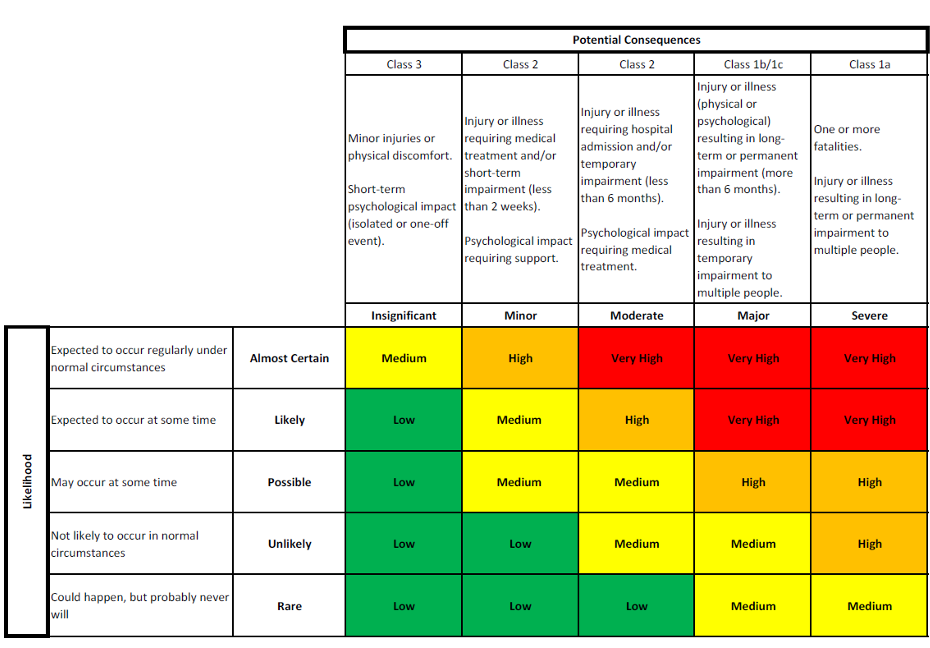
The risk matrix defines:
- Likelihood levels: Rare, Unlikely, Possible, Likely, Almost Certain
- Consequence levels: Insignificant, Minor, Moderate, Major, Severe
- Risk ratings: Low, Medium, High, Very High
End of Risk Assessment
Related Documents
- Safe Work Procedure - Detailed operating procedures
Document Control
| Version | Date | Author | Changes |
|---|---|---|---|
| 1.0 | 2026-09-18 | Chris Betters | Initial release |